
All-Over Print 3D T-Shirts
A 3D t-shirt uses all-over print sublimation to wrap artwork edge to edge across the entire garment, covering the front, back, and sleeves in a single continuous design. Unlike standard DTG tees where the graphic sits on the chest, a 3D print t-shirt treats the entire garment as a canvas. The sublimation process fuses dye directly into the fabric fibers rather than layering ink on top, which produces vivid colors that do not crack or peel over time. This collection currently features two distinct 3D t-shirt designs at different price points.
Current 3D T-Shirt Designs
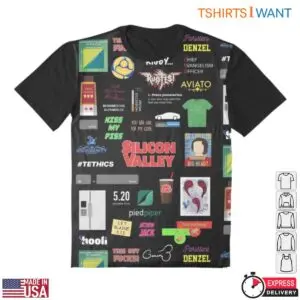
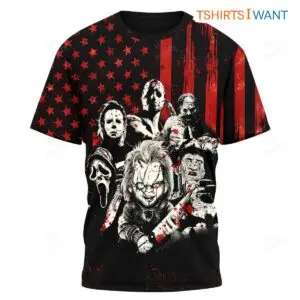
The catalog contains two designs that demonstrate different ends of the 3D graphic t-shirt spectrum. One features a dark, horror-themed American flag motif with complex gradients and layered imagery, priced at $39.95 to reflect the detail density. The other offers tech-focused pop culture humor in a lighter style, available at $19.95. Both use the same full-coverage sublimation process, but the higher-priced design involves more complex color work. Additional 3D t-shirt designs enter the catalog as new artwork becomes available.
How 3D Print T-Shirts Differ from Standard Tees
Standard graphic tees use direct-to-garment printing to place a design on the chest area of a cotton shirt. A 3D t-shirt uses a fundamentally different process: dye sublimation on a polyester or poly-blend fabric, where heat and pressure transfer the artwork into the fibers themselves. The result is a seamless, full-coverage graphic with no visible print boundaries. The colors stay vibrant through repeated washes because the dye is part of the fabric rather than a surface layer. The fabric weight and feel differ from a heavy cotton tee, offering a smoother, lighter hand.
Styling and Wearing 3D Graphic T-Shirts
Because 3D graphic tees carry bold, full-coverage artwork, they work best as the primary visual element of an outfit. Pairing them with solid-colored bottoms in dark or neutral tones lets the all-over print design stand out without visual competition. Layering under an open jacket frames the chest artwork while keeping the overall look balanced. The lighter fabric weight makes 3D t-shirts comfortable for warm-weather wear and indoor events where a heavier cotton tee might feel too warm.
Care Instructions for 3D Tee Shirts
Machine wash cold with the garment turned inside out to protect the sublimated surface. Tumble dry on a low setting or hang dry. Do not bleach, and keep the iron away from the printed area. Because the sublimation dye is fused into the fibers, the artwork resists fading and peeling under normal wash conditions, maintaining color vibrancy over many cycles.
Browse the parent All-Over Print collection or back to 3D t-shirts.
Common Questions About 3D T-Shirts
What is a 3D t-shirt?
A 3D t-shirt features all-over print artwork that covers the entire garment — front, back, and sleeves — using dye sublimation rather than standard chest-area printing. The result is a seamless, edge-to-edge graphic.
How are 3D print t-shirts made?
The artwork is transferred into the fabric using heat-activated dye sublimation. This process fuses the color into the fibers rather than layering ink on top, producing vivid, crack-resistant graphics across the full garment.
Will the artwork on 3D tee shirts fade or peel?
No. Because sublimation bonds the dye directly into the fabric fibers, the artwork does not crack, peel, or fade under normal washing conditions.
How many 3D t-shirt designs are currently available?
The collection currently features two distinct designs: a horror-themed American flag motif at $39.95 and a tech humor design at $19.95. New designs are added as artwork becomes available.
How should 3D graphic t-shirts be washed?
Machine wash cold and inside out, tumble dry on a low setting, skip the bleach, and keep the iron away from the printed surface.
How do 3D t-shirts fit compared to standard tees?
The sublimation process typically uses a polyester or poly-blend fabric with a smoother, lighter hand than heavy cotton. Check the product page for the exact size chart and fabric details for each design.